
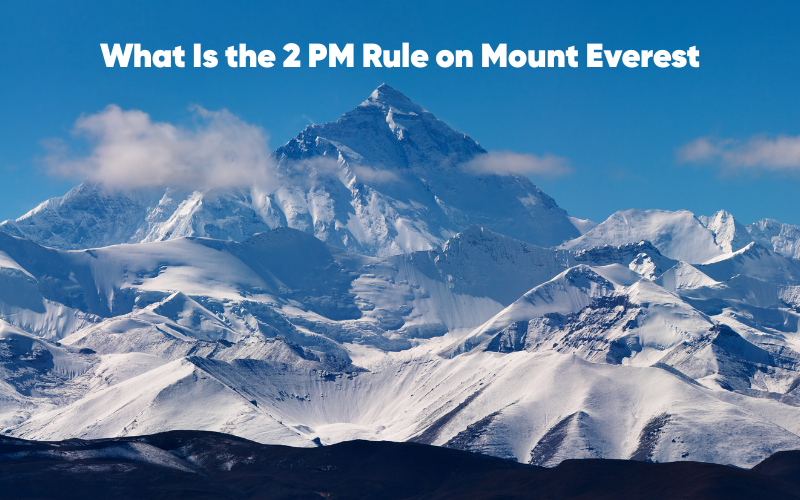
The 2 PM rule on Mount Everest is a safety guideline requiring climbers to turn back if they have not reached the summit by 2:00 PM. The rule exists to prevent climbers from descending in darkness, running out of oxygen, or facing worsening afternoon weather in the Death Zone above 8,000 meters. It is one of the most important Everest summit safety rules.
Why Does the 2 PM Rule Exist?
The 2 PM turnaround rule on Everest is based on survival science, weather patterns, and decades of fatal summit attempts. Above 8,000 meters, small delays can become deadly.
The Death Zone Above 8,000 Meters
Mount Everest rises to 8,848.86 meters, and anything above 8,000 meters is known as the Death Zone.
At this altitude:
- Oxygen levels drop to roughly one-third of sea level
- Brain function slows dramatically
- Coordination and judgment decline
- The body begins deteriorating
The human body cannot acclimatize permanently at this elevation. Prolonged exposure significantly increases fatal risk.
Oxygen Supply Limitations
Supplemental oxygen bottles used on Everest have limited duration.
- Most bottles last only several hours
- Climbers carry a calculated supply
- Extra oxygen is rarely available
If a climber summits late and oxygen runs out during descent, survival chances decrease rapidly. Running out of oxygen in the Death Zone is one of the primary causes of high-altitude fatalities.
Afternoon Weather Risks
Weather on Everest often deteriorates after midday.
- Winds typically increase
- Temperatures drop sharply
- Cloud cover and whiteout conditions develop
Descending in worsening afternoon weather dramatically increases risk, especially on exposed ridges.
Most Deaths Happen During Descent
Statistics show that many Everest deaths occur after reaching the summit.
Reasons include:
- Severe exhaustion
- Poor decision-making
- Oxygen depletion
- Darkness complicating navigation
The summit is only halfway. The descent is when climbers are most vulnerable.
How the 1996 Everest Disaster Reinforced the Rule
The 1996 Mount Everest disaster is one of the most well-known tragedies in Everest history.
During that season:
- Several climbers reached the summit late
- Turnaround times were exceeded
- A sudden storm struck the mountain
- Delayed descents led to multiple fatalities
The disaster reinforced the importance of strict Everest summit turnaround times. It demonstrated how summit fever and late summits can quickly turn fatal in the Death Zone.
What Is “Summit Fever”?
Summit fever refers to the overwhelming psychological drive to reach the top at any cost.
It can be influenced by:
- Years of preparation
- Financial investment
- Personal ambition
- External pressure
- Ego and achievement goals
In the Death Zone, oxygen deprivation impairs judgment, making climbers more likely to ignore safety limits.
The 2 PM rule exists specifically to override emotional decision-making with a clear, non-negotiable boundary.
What Does a Typical Everest Summit Day Look Like?
A standard Everest summit day timeline usually follows this pattern:
| Time | Activity |
|---|---|
| 9–11 PM | Leave Camp IV (South Col) |
| 4–7 AM | Reach Balcony / South Summit |
| 6–10 AM | Ideal summit window |
| Before 2 PM | Mandatory turnaround time |
Most experienced guides aim for a summit between 6 AM and 10 AM to allow sufficient time for descent.
What Happens If Climbers Ignore the 2 PM Rule?
Ignoring the Everest summit turnaround time increases the risk of:
- Oxygen depletion
- Frostbite
- Exposure to storms
- Navigating steep terrain in darkness
- Cognitive failure due to hypoxia
Late summits often lead to dangerously slow descents. In the Death Zone, delays multiply risk exponentially.
Is the 2 PM Rule an Official Law?
The 2 PM rule is not a legal regulation, but it is a widely accepted safety protocol.
- Strongly enforced by professional guides
- Set by expedition leaders
- Treated as a strict operational rule
Modern guiding companies consider it a non-negotiable safety boundary.
How Modern Expeditions Enforce Turnaround Times
Today’s Everest expeditions use structured safety systems:
- Strict guide policies
- Real-time radio communication
- Oxygen level monitoring
- Traffic management at bottlenecks
These systems reduce the likelihood of dangerously late summits.
The Science Behind Late Summits
Hypoxia (low oxygen) affects the body in measurable ways:
- Slowed reaction time
- Impaired judgment
- Reduced coordination
- Accelerated fatigue
Energy reserves are often depleted by afternoon. Nightfall compounds danger, as cold intensifies and navigation becomes more complex.
Late summits are not just risky — they are scientifically dangerous.
Frequently Asked Questions
What is the turnaround time on Everest?
Most expeditions enforce a 1–2 PM turnaround rule to ensure safe descent.
Why is 2 PM considered too late to summit?
Because descending after 2 PM increases the likelihood of darkness, oxygen depletion, and worsening weather.
Do all climbers follow the 2 PM rule?
Professional guided expeditions enforce it strictly, though independent climbers may sometimes ignore it.
What is summit fever on Everest?
It is the psychological drive to reach the summit despite worsening safety conditions.
Why do most Everest deaths occur during descent?
Climbers are exhausted, low on oxygen, and descending in deteriorating weather.
Conclusion
The 2 PM rule on Mount Everest is not about limiting ambition — it is about survival. It serves as a life-saving boundary between determination and disaster.
On Everest, one principle remains true:
The summit is optional. The descent is mandatory.
The 2 PM rule ensures that climbers respect that reality in the most extreme environment on Earth.


Leave a Reply