
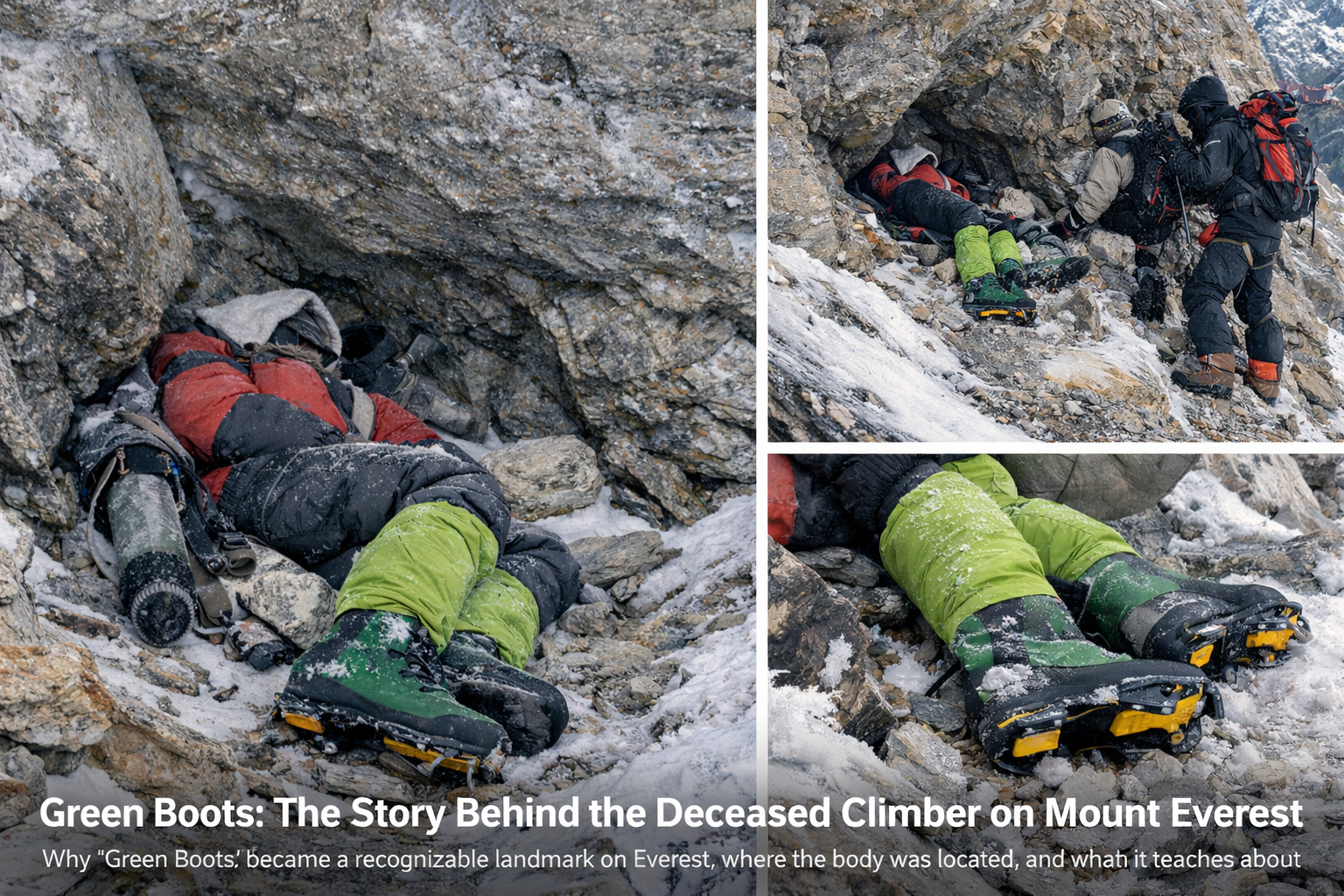
The name “Green Boots” often surfaces in online discussions about mount Everest—sometimes with shock, sometimes with myth, and often without context. This article takes a calm, factual, and respectful look at what is actually known, what is assumed, and why the story matters—not as spectacle, but as education.
Who Is “Green Boots” on Mount Everest?
“Green Boots” is a nickname given by climbers to an unidentified mountaineer whose body became a recognizable landmark on Everest’s Northeast Ridge route.
- The name comes from distinctive green mountaineering boots
- The body was visible for years near a small rocky recess
- The story is frequently misunderstood and exaggerated online
This nickname was never meant for publicity—it emerged from practical communication in an extreme environment.
Why the Name “Green Boots” Became Well Known
In high-altitude climbing, landmarks are essential.
- Why climbers use landmarks: At extreme altitude, visibility, memory, and cognition are impaired. Clear reference points help teams communicate location and progress.
- How the nickname spread: Expedition briefings, word-of-mouth among climbers, and later internet retellings amplified the name.
- Folklore vs. facts: Over time, repeated retellings blurred the line between verified information and assumption.
Where Was Green Boots Located on Mount Everest?
The Northeast Ridge Route
- Located on the Tibet (north) side of Everest
- Considered one of the most technically demanding routes
- Positioned in the “Death Zone”—above ~8,000 meters, where the human body cannot acclimatize
At this altitude, oxygen is scarce, decision-making is impaired, and physical strength declines rapidly.
The So-Called “Green Boots Cave”
- A small rock alcove, not an intentional shelter
- Climbers sometimes paused briefly to adjust gear
- Resting too long is dangerous at extreme altitude
- It was never designed—or used—as a safe haven
Who Was Green Boots?
- Often linked to an Indian climber from the 1996 Everest season
- No official confirmation has ever been released
- Identification has remained uncertain out of respect and lack of verifiable records
Separating documented fact from speculation is essential—especially when discussing real human lives.
Why Bodies Are Sometimes Left on Mount Everest
Extreme Altitude Limitations
- Above 8,000 meters, oxygen levels drop to about one-third of sea level
- Even simple movements can require immense effort
- Survival, not recovery, becomes the priority
Why Recovery Is Rare
- Severe risk to rescuers
- Dangerous terrain and unpredictable weather
- Ethical decisions made in life-threatening conditions
Leaving a body behind is never casual—it’s often the only viable option.
What Happened to Green Boots?
In later years, climbers reported no longer seeing the body.
Possible explanations include:
- Relocation by authorities or expeditions
- Natural concealment by snow and rock movement
- Intentional removal for privacy and respect
No official public statement has clarified the outcome—and that discretion is intentional.
What the Story of Green Boots Teaches About Everest
Experience Matters More Than Ambition
Everest rewards preparation—not desire.
Turning Back Is a Valid Decision
Many successful climbers survive because they choose to descend.
Everest Has Human Limits
No amount of gear removes biological reality.
Respect for Those Who Came Before
Every climber understands the cost paid by others.
Why the Internet Obsessively Talks About Green Boots
- Shock value drives clicks
- Social media favors simplified, dramatic narratives
- Context and nuance are often stripped away
Education rarely spreads as fast as sensation—but it matters more.
Is It Disrespectful to Talk About Green Boots?
It depends how the story is told.
- Learning with respect honors those involved
- Sensationalizing reduces a human life to entertainment
- Responsible storytelling preserves dignity and truth
Most climbers view remembrance as acceptable—exploitation is not.
Everest Today vs. the Past
- Improved weather forecasting
- Better logistical support
- Increased regulation (still imperfect)
Yet Everest remains unforgiving. Technology reduces risk—it does not eliminate it.
Final Thoughts – Green Boots as a Symbol, Not a Spectacle
Green Boots represents:
- The real cost of extreme altitude
- Human vulnerability in hostile environments
- Why Everest should never be underestimated
The story isn’t about death—it’s about limits, humility, and respect.
Frequently Asked Questions
Why is Green Boots called Green Boots?
Because of the climber’s distinctive green mountaineering boots.
Was Green Boots a real person?
Yes. A real climber, though identity has never been officially confirmed.
Where was Green Boots located on Everest?
On the Northeast Ridge route, in the Death Zone on the north side.
Why can’t bodies be easily recovered from Everest?
Extreme altitude, danger to rescuers, and terrain make recovery life-threatening.
Is Green Boots still on Mount Everest?
He has not been seen in recent years; the exact outcome is unknown.
What does Green Boots symbolize?
The human cost of high-altitude climbing and the importance of respect and restraint.

Leave a Reply