
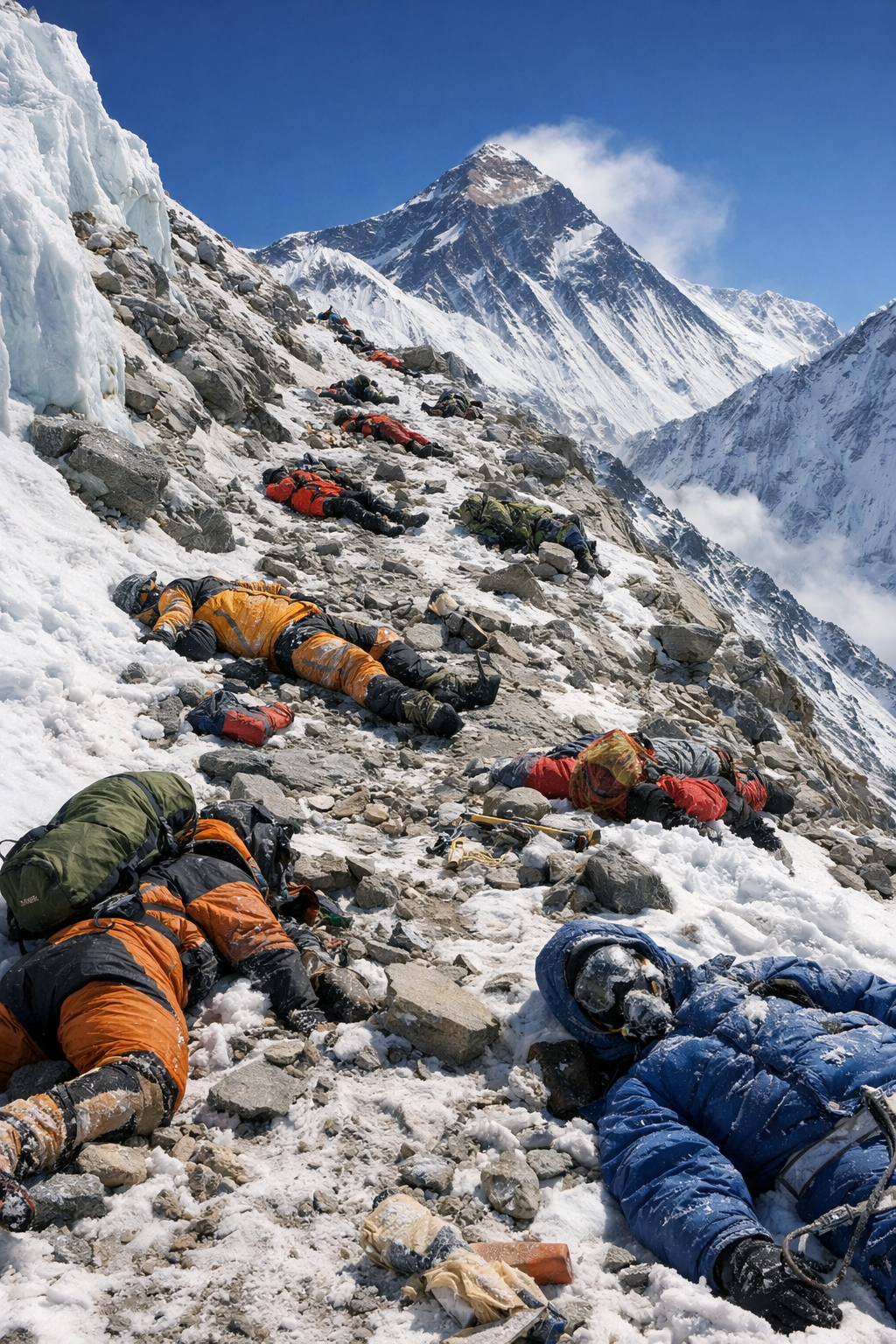
Mount Everest’s beauty is matched only by its brutality. Among the questions people ask most frequently about the world’s highest peak is one that reflects both curiosity and unease: how many bodies remain on the mountain? This article provides factual estimates, explains why recovery is so rare, and offers respectful context about what these numbers really represent—not sensational stories, but the sobering reality of extreme-altitude mountaineering.
Quick Answer
Estimated number of bodies on Mount Everest: 200–300
The exact number is unknown because:
- Not all deaths are documented: Early expeditions in the 1920s-1950s had incomplete records, and some climbers died in remote areas with no witnesses
- Some bodies are buried by snow and ice: Everest’s extreme weather constantly reshapes the landscape through avalanches, snowfall, and glacier movement
- Some have been removed or relocated: Recovery efforts—though rare and dangerous—have successfully brought down or repositioned certain remains over the decades
- Accessible vs inaccessible terrain: Many deaths occurred in areas that are rarely or never revisited, making verification impossible
What we know with certainty: Over 330 people have died on Mount Everest since the first expeditions began in the 1920s. A significant portion of those remains—likely 60-75%—are still on the mountain in various states and locations.
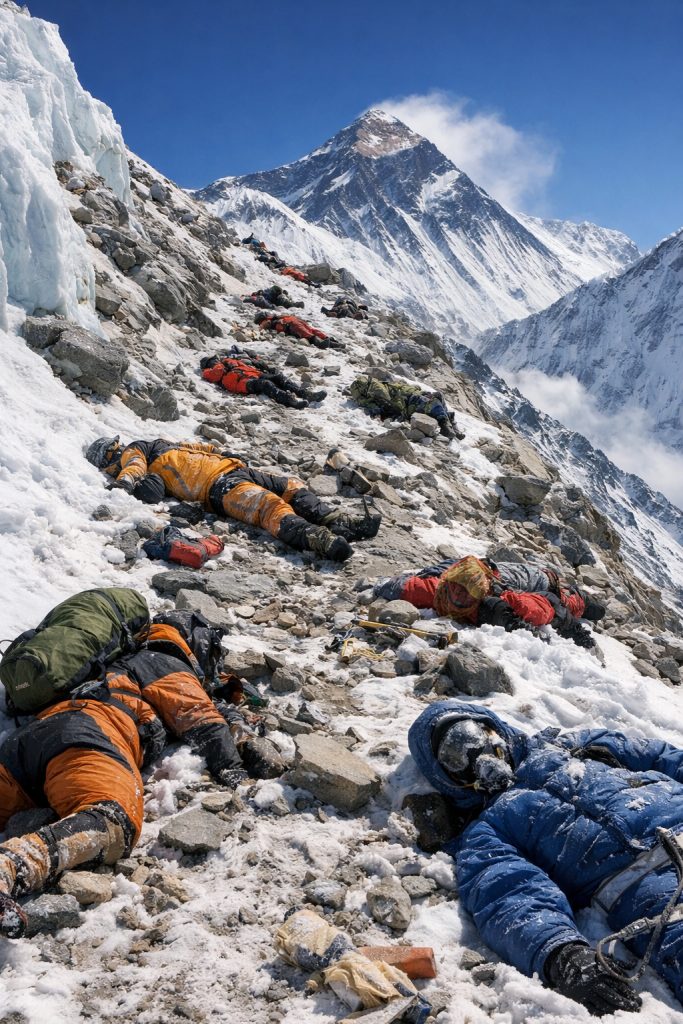
Why There Is No Exact Number
Unlike a cemetery with documented graves, Mount Everest offers no reliable inventory of human remains. Several factors make an accurate count impossible:
Incomplete Historical Records
Early expedition documentation (1920s-1960s):
- Climbing teams were small, often with minimal support
- Record-keeping focused on success, not comprehensive death documentation
- Communication from base camp to the outside world was extremely limited
- Some deaths occurred when climbers were alone or separated from their group
- Political tensions (especially around Tibet/China access) complicated information sharing
Example: The 1924 disappearance of George Mallory and Andrew Irvine remained a mystery until Mallory’s body was discovered in 1999—75 years later. Irvine’s body has never been found, though he is presumed to have died on the mountain.
Natural Concealment
Everest is not a static environment. The mountain actively transforms itself through:
Snowfall accumulation: Heavy seasonal snow can bury remains completely, sometimes for decades. Bodies that were visible one season may disappear the next.
Avalanche activity: Massive snow and ice avalanches occur regularly, capable of moving bodies hundreds of meters or burying them under tons of debris.
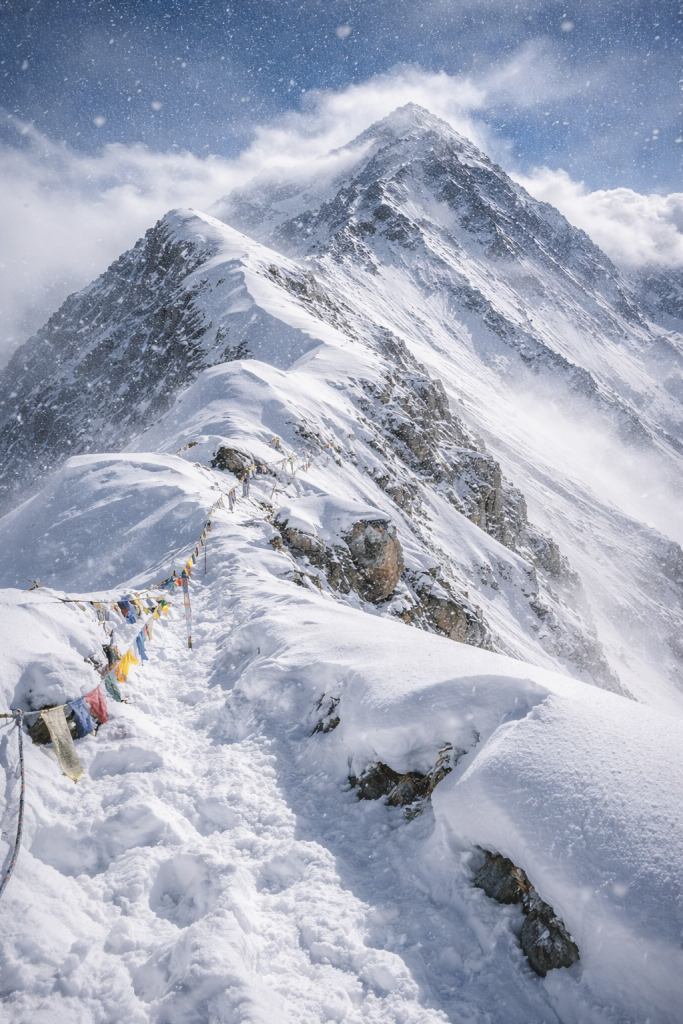
Glacier movement: The Khumbu Glacier and other ice formations flow slowly downward, carrying anything frozen within them. Bodies can gradually migrate to different elevations or become exposed decades after death.
Wind erosion and deposition: Everest’s hurricane-force winds constantly redistribute snow and ice, alternately exposing and concealing remains.
Crevasse falls: Climbers who fall into deep crevasses are often never recovered and may never be found, swallowed by the mountain’s shifting ice.
Recoveries Over Time
While recovery is exceptional rather than routine, it does happen:
High-profile recovery missions: Some well-known climbers’ remains have been brought down or relocated through dedicated, expensive expeditions.
Quiet family-funded operations: Some families arrange private recovery efforts that are conducted discreetly and not publicized.
Partial recoveries: Sometimes only equipment or partial remains are retrieved, leaving uncertainty about whether the entire body was accounted for.
Repositioning rather than removal: In some cases, remains have been moved from highly visible locations to more sheltered positions rather than brought entirely off the mountain.
Remote Terrain
Large sections of Everest are:
- Technically dangerous to access even for experienced climbers
- Visible only from specific angles or routes
- Located in areas with no reason for climbers to visit
- Hidden in couloirs, on cliff faces, or in ice fields rarely traversed
Verification is impossible for many suspected death locations. Without visual confirmation or recovery, we cannot know with certainty whether remains are present.
Where Most Bodies Are Located
The distribution of bodies on Everest is not random—it directly correlates with altitude, route difficulty, and the physiological limits of human survival.
High-Altitude Zones
The overwhelming majority of bodies are located above 8,000 meters (26,247 feet) — the so-called Death Zone where the human body cannot survive for extended periods.
Common locations include:
Summit ridges (both routes):
- The Hillary Step area on the Southeast Ridge (Nepal side)
- The Second and Third Steps on the Northeast Ridge (Tibet side)
- The Balcony (8,400m) on the South Col route
- The final summit push slopes where exhaustion peaks
Upper camps:
- Camp 4 / South Col (7,950m) area
- High Camp on the North Col route
- Areas where climbers attempted to bivouac (emergency overnight stops)
Difficult technical sections:
- The Khumbu Icefall (though this is below the Death Zone at 5,486-5,943m, it’s extremely dangerous due to constantly shifting ice blocks and crevasses)
- The Lhotse Face (steep ice wall requiring fixed ropes)
- The Kangshung Face (East Face, rarely attempted due to extreme difficulty)
- Narrow couloirs and exposed ridges where single mistakes are fatal
Why these areas?
Oxygen deprivation is extreme: Above 8,000m, even with supplemental oxygen, the body is slowly dying. Decision-making becomes impaired, physical coordination deteriorates, and the ability to self-rescue vanishes.
Technical difficulty compounds altitude: Navigating rock steps, ice walls, and exposed ridges while oxygen-deprived and exhausted creates lethal risk.
Weather changes rapidly: Climbers caught in sudden storms at these elevations rarely survive. Whiteout conditions, extreme cold, and hurricane winds can kill within hours.
The descent is when most deaths occur: Exhausted climbers who successfully reached the summit often die on the way down when their oxygen runs out, their physical reserves are depleted, and their judgment is severely compromised.
Why Lower Areas Have Fewer Bodies
Below approximately 7,000 meters (22,966 feet), death is far less common, and when it does occur, recovery is much more feasible:
Easier access for rescue teams:
- Helicopters can operate effectively up to approximately 7,000-7,500m in optimal conditions
- Rescue teams can function with better cognitive ability and physical capacity
- More climbers and Sherpas are present in lower camps who can assist
More oxygen and manpower:
- Rescuers don’t face the same debilitating physiological effects
- Multiple people can work together to move an injured or deceased person
- Supplemental oxygen for rescuers is more available and practical to use
Safer evacuation conditions:
- Terrain is generally less technical
- Weather, while still dangerous, is less instantly lethal
- Fixed ropes, established camps, and communication systems function better
Cultural and ethical factors:
- Lower on the mountain, it’s considered both possible and morally necessary to recover remains
- Sherpa communities, in particular, have strong cultural reasons to bring fallen climbers down when feasible
- The trekking community and support infrastructure make recovery operations more practical
Why Bodies Are Often Left on Everest
This is the question that troubles many people: how can remains simply be left behind? The answer is complex, rooted in extreme physiology, rescue ethics, and the brutal reality of the Death Zone.
Extreme Altitude Limits
Very low oxygen availability: At Everest’s summit, the air contains only 33% of the oxygen available at sea level. Even at 8,000 meters, you’re functioning at roughly 40% oxygen capacity. The effects include:
- Severe exhaustion: Every movement requires monumental effort. Climbers describe lifting each foot as if it weighs hundreds of pounds.
- Cognitive impairment: Judgment becomes dangerously clouded. Climbers make irrational decisions, forget basic procedures, and cannot process risk accurately.
- Extreme physical decline: The body begins consuming its own muscle tissue for energy. Core temperature regulation fails. Coordination deteriorates to the point where climbers stumble on flat ground.
At these altitudes, even healthy, oxygen-supplemented climbers are barely functional. The idea of carrying or dragging another person—alive or deceased—becomes physiologically impossible for most individuals.
Rescue Risk and Ethical Reality
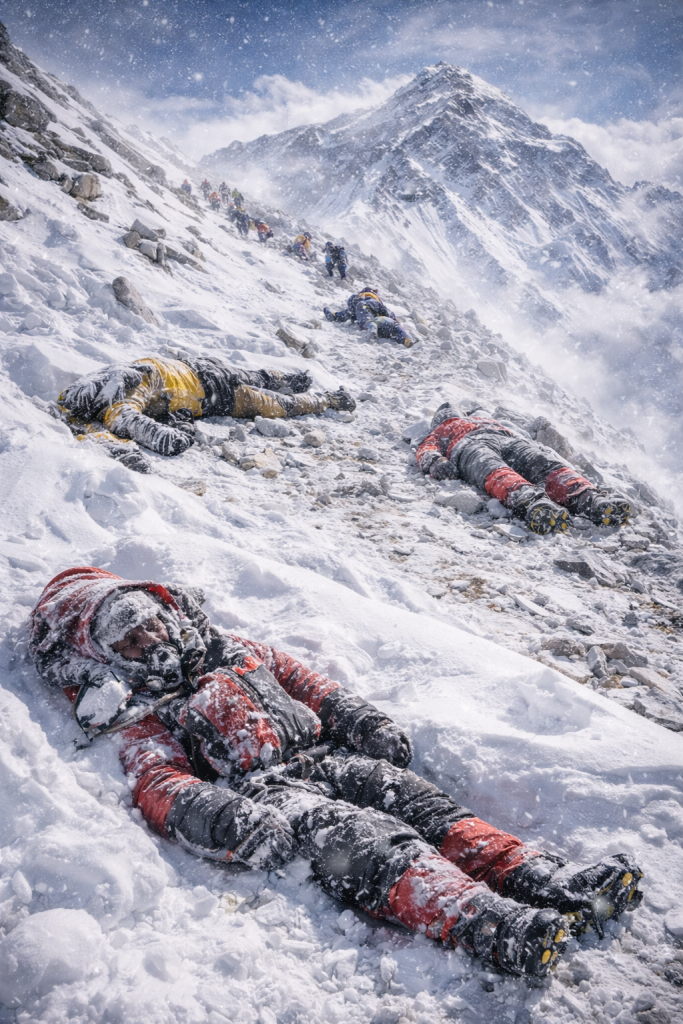
The mountaineering community has an unwritten but widely understood rule: above a certain altitude, you cannot save someone who cannot save themselves.
Why attempting rescue often creates multiple casualties:
Physical impossibility: A human body, frozen solid and wearing mountaineering gear, can weigh well over 100 kilograms (220+ pounds). Moving this weight across steep ice, narrow ridges, and vertical rock sections while oxygen-deprived is nearly impossible.
Rescuer endangerment: Every minute spent at extreme altitude increases the risk to those attempting rescue. Altitude sickness, frostbite, exhaustion, and sudden weather changes threaten everyone involved.
Resource depletion: Rescue attempts consume oxygen, energy, and time that climbers need to save themselves. Depleting these resources for a deceased person can turn rescuers into additional victims.
The “window of viability” is extremely narrow: If someone is alive but incapacitated above 8,000m, there are perhaps 1-3 hours to coordinate rescue before everyone involved faces lethal danger. For someone already deceased, the ethical calculation becomes even clearer—risking multiple lives to recover remains is generally considered unjustifiable.
Notable exceptions: Heroic rescue efforts DO occasionally succeed, typically when:
- The person is still alive and can partially assist
- Weather conditions are unusually favorable
- Multiple strong climbers and Sherpas are immediately available
- The location is on a main route with fixed ropes
- Supplemental oxygen is abundant
But these conditions rarely align simultaneously, and even “successful” high-altitude rescues are extraordinarily dangerous.
Logistical Reality
Even when there’s consensus that recovery should be attempted, practical barriers are immense:
Weight and terrain:
- A body frozen to the mountain must first be chipped free from the ice
- Steep slopes mean any moved weight could trigger falls or avalanches
- Cliff sections require complex rope systems and anchors
- Ice and rock don’t reliably hold anchors at extreme altitude
Weather constraints:
- Recovery requires extended time in the Death Zone
- Weather windows above 8,000m are brief and unpredictable
- Storms can trap recovery teams, creating additional emergencies
Cost considerations:
- Professional high-altitude recovery operations cost $40,000-$100,000 or more
- Requires hiring elite Sherpa climbers willing to take extreme risk
- Specialized equipment, helicopter support (where possible), and extensive planning
- Many families cannot afford these costs; others choose not to prioritize recovery over memorialization
Permit and political issues:
- Both Nepal and China (Tibet) require special permits for recovery operations
- Bureaucratic delays can eliminate weather windows
- Political sensitivities sometimes complicate cross-border coordination
Have Bodies Ever Been Removed?
Yes—but recovery is rare, dangerous, and typically reserved for specific circumstances.
Successful Recovery Efforts
Some notable examples:
Francys Arsentiev (1998 death, 2007 recovery): Known posthumously as “Sleeping Beauty,” her body was visible on the Northeast Ridge for nine years before Ian Woodall—who had encountered her dying in 1998—returned specifically to move her remains to a less visible location. This wasn’t full removal but repositioning out of respect.
George Mallory (discovered 1999): Found 75 years after his 1924 disappearance. His body was partially buried on-site with a Buddhist ceremony rather than fully removed, respecting both the deceased and the mountain.
Hannelore Schmatz (1979 death): The body of the first woman to die on Everest’s descent was visible for years but was eventually moved or buried by natural snowfall—reports vary on whether this was intentional human action or natural concealment.
Shriya Shah-Klorfine (2012 death, 2013 recovery): Her body was brought down from the Balcony area by a team of Sherpas the following season—a relatively rare full recovery from above 8,000m.
What Recovery Requires
Large, experienced teams: Typically 6-12 highly skilled Sherpa climbers who are willing to accept extraordinary risk.
Ideal weather conditions: Multiple consecutive clear days with minimal wind—a rare occurrence at extreme altitude.
Significant funding: $50,000-$100,000+ depending on location, altitude, and complexity. Some families fundraise; others cannot afford it.
Proper permits: Official approval from Nepali or Chinese authorities, which can take months to secure.
Specialized equipment: High-strength rope systems, pulleys, sleds, protective wrapping, supplemental oxygen for the recovery team, and communication equipment.
Ethical and cultural considerations: Many recovery operations are conducted quietly to respect the deceased’s family, the climbing community, and the sanctity of the mountain itself.
Why Many Removals Are Kept Private
Family privacy: Loved ones often prefer that recovery operations not become media spectacles.
Cultural respect: Sherpa Buddhist traditions around death and the mountain are deeply personal.
Avoiding precedent: Publicizing successful recoveries can create pressure for additional dangerous operations.
Protecting participants: High-altitude recovery climbers often don’t want recognition for work they consider morally necessary but physically horrifying.
Are Bodies Used as “Landmarks”?
This claim circulates widely online, but the reality is far more nuanced and considerably less sensational than internet narratives suggest.
The Exaggeration
What people believe: That Everest is full of named bodies used casually as mileage markers, with climbers stopping for selfies and treating human remains as tourist attractions.
The reality: This portrayal is largely inaccurate and disrespectful both to the deceased and to the climbing community.
What Actually Happens
In reality:
Climbers focus on routes, ropes, and terrain: Navigation at extreme altitude relies on fixed ropes, GPS coordinates, pre-planned camp locations, and visible terrain features like rock formations and ice features.
Any human remains are treated with seriousness: Experienced guides and climbers approach these situations with gravity, not casual curiosity. Many climbers report that encountering remains is psychologically disturbing and serves as a sobering reminder of the mountain’s dangers.
The “Green Boots” phenomenon was unique: The widely discussed “Green Boots” became known precisely because the location was an unavoidable narrow passage on the Northeast Ridge where climbers had no choice but to pass close by. This was geographical necessity, not intentional landmark use.
Visibility varies by route: The vast majority of Everest climbers on the popular Southeast Ridge route (Nepal side) never see any human remains at all. Bodies are far more likely to be encountered on the less-trafficked Northeast Ridge (Tibet side).
The Mountain Environment Creates Unavoidable Visibility
Why some remains are visible:
Routes are constrained: At extreme altitude, climbers must follow established routes with fixed ropes. There’s often no alternative path—you go where the ropes lead, regardless of what’s there.
The mountain is barren: Above 7,000m, there’s no vegetation, no soil, no place for natural concealment except snow and ice. Anything not buried stands out starkly against gray rock and white snow.
Colors are vivid: Modern mountaineering gear is brightly colored for visibility and safety. These colors remain vivid in the cold, creating high contrast with the monochrome environment.
Psychological impact: What climbers notice and remember is not necessarily what they seek out. Encountering human remains at extreme altitude—where your own survival is uncertain—creates powerful, disturbing memories that sometimes get mischaracterized as “landmark navigation.”
The Truth About Mountaineering Culture
Professional guides and experienced climbers universally describe:
- Sadness and reflection upon encountering remains
- Increased caution and awareness of risk
- Respect for the person who died
- Desire to avoid sensationalizing the experience
The internet’s fascination with “body landmarks” reveals more about our culture’s morbid curiosity than about actual mountaineering practice.
How This Compares to Other Mountains
Everest is unique in the visibility and preservation of human remains, but not because it’s uniquely deadly. Several factors create this distinction:
Why Everest Has More Visible Remains
Extremely high altitude slows natural decomposition:
- Temperatures consistently below freezing preserve organic material
- Low oxygen levels inhibit bacterial activity that would normally cause decay
- UV radiation is intense, but the cold prevents rapid breakdown
- Bodies can remain relatively intact for decades
Heavy traffic on a few fixed routes:
- Everest sees 600-800 summit attempts annually in recent years
- Most climbers follow two primary routes (Southeast and Northeast ridges)
- Concentrated traffic means remains on these routes are more likely to be encountered and documented
- Other mountains have lower traffic and more dispersed routes
Extended time in the Death Zone:
- Everest’s extreme altitude means climbers spend more time above 8,000m than on most other peaks
- Longer exposure equals higher cumulative risk
- More deaths occur in the specific high-altitude zones where recovery is impossible
Comparison to Other 8,000m Peaks
K2 (8,611m – second highest):
- Similar death rate to Everest (approximately 1 death per 4-5 summits historically)
- Far fewer total deaths (approximately 90 vs 330+) due to much lower traffic
- Equally difficult recovery conditions
- Fewer bodies remain visible because fewer total climbers have died there
Annapurna I (8,091m – 10th highest):
- Historically the deadliest 8,000m peak (fatality rate around 30%+, now improved but still high)
- Fewer total deaths than Everest despite higher percentage
- Avalanche-prone terrain means many bodies were buried naturally
Kangchenjunga (8,586m – third highest):
- Lower traffic, fewer deaths
- Similar recovery challenges
- Less documented due to remote location and fewer expeditions
Lower Mountains Allow Recovery
Mountains below 7,000-7,500m:
- Helicopter evacuation is often possible
- Rescue teams can function more effectively
- Cultural and legal requirements often mandate recovery efforts
- Local communities typically have the capability and will to retrieve remains
Examples:
- Mont Blanc (4,810m): Despite high accident rates, nearly all remains are recovered
- Denali/McKinley (6,190m): US National Park Service conducts recovery operations
- Aconcagua (6,961m): Argentine authorities typically recover deceased climbers
The key difference: Below the Death Zone, recovery is difficult but achievable. Above 8,000m, it often simply isn’t.
What This Tells Us About Everest
The presence of 200-300 bodies on Everest isn’t evidence of callousness or disregard for human life. It’s evidence of extreme-altitude physiology, the limits of rescue capability, and the mountain’s fundamental indifference to human ambition.
Everest Is Logistically Unforgiving
It’s not just physically difficult:
- The mountain doesn’t offer second chances
- Mistakes that would be recoverable at lower altitude become fatal at 8,000m+
- There’s no rescue service that can reliably save you
- Technology helps, but cannot eliminate fundamental physiological limits
Experience and Decision-Making Matter More Than Strength
Many deaths involve:
- Experienced climbers who made single fatal errors in judgment
- Summit fever overriding rational risk assessment
- Turning back too late (many deaths occur during descent after successful summits)
- Weather changes that were predictable but ignored
- Exhaustion that impairs judgment at critical moments
Physical fitness alone is insufficient. Knowing when to turn around, recognizing altitude sickness symptoms in yourself and others, and maintaining conservative decision-making while oxygen-deprived are far more important than raw athleticism.
Altitude Illness and Weather Are the Primary Killers
Common causes of Everest deaths:
High Altitude Pulmonary Edema (HAPE): Fluid accumulates in the lungs, causing death by drowning in your own fluids. Can develop rapidly and is often fatal if descent isn’t immediate.
High Altitude Cerebral Edema (HACE): Brain swelling causes disorientation, loss of coordination, coma, and death. Requires immediate descent—impossible in many high-altitude situations.
Sudden weather changes: Climbers caught in storms can die from hypothermia, get blown off exposed ridges, or become disoriented and lost.
Exhaustion and depletion: Running out of supplemental oxygen, energy, or willpower in the Death Zone means you simply stop—and stopping means dying.
Falls and avalanches: Technical errors, equipment failure, or simply exhaustion-induced missteps can be instantly fatal on exposed terrain.
The Importance of Humility
Every body on Everest represents someone who:
- Trained extensively
- Invested enormous financial resources
- Was passionate about mountaineering
- Believed they could succeed
- Made a decision—either in planning, execution, or emergency response—that proved fatal
These weren’t reckless amateurs (though some deaths do involve inexperienced climbers). Many were highly skilled mountaineers who simply encountered circumstances beyond human capacity to overcome.
The lesson: Everest demands absolute humility. The mountain doesn’t care about your resume, your determination, or your dreams. Respect and conservative decision-making are the only reliable survival strategies.
Common Myths (Debunked)
Internet folklore has created numerous misconceptions about bodies on Everest. Here’s what’s actually true:
Myth: “Everest is covered in bodies everywhere you look”
Reality: The vast majority of Everest is completely free of visible human remains. Most climbers complete the entire trek and climb without seeing any bodies at all, especially on the popular Southeast Ridge route from Nepal. The bodies that do exist are concentrated in specific high-altitude areas, and even there, they’re not densely distributed. Sensationalist articles create the false impression of a mountain “littered” with corpses—this is factually inaccurate.
Myth: “Climbers ignore dying people casually”
Reality: The reality is far more complex and tragic. At extreme altitude, helping someone who cannot help themselves often means creating additional casualties. The few documented cases of climbers passing dying individuals occurred in circumstances where:
- The person was beyond saving (already unconscious or in late-stage fatal altitude sickness)
- Stopping would have killed the would-be rescuer as well
- Multiple people were already trying to help without success
These are agonizing ethical situations, not casual indifference. Many climbers who faced these decisions suffer lasting psychological trauma. The judgment of people sitting safely at sea level does not reflect the impossible reality of these moments.
Myth: “Bodies are left intentionally as markers”
Reality: Bodies remain on Everest because recovery is dangerous, expensive, and often impossible—not because anyone wants them there as navigation aids. The climbing community would prefer these remains were recovered respectfully. When recovery is feasible and funded, it is attempted. The “landmark” narrative is an internet distortion that disrespects both the deceased and the climbing culture.
Myth: “The cold perfectly preserves bodies like they’re sleeping peacefully”
Reality: While extreme cold does slow decomposition, bodies on Everest are subjected to:
- Hurricane-force winds that can exceed 200 mph
- Intense UV radiation at altitude
- Dramatic temperature swings
- Physical impacts from moving ice and falling rocks
- Decades of weathering
The “peacefully sleeping” narrative is a romanticized fiction that doesn’t reflect the harsh reality of what extreme altitude does to human remains over time.
Myth: “Everest is far more dangerous than other 8,000m peaks”
Reality: Everest’s fatality rate (approximately 4%, or 1 death per 25 summit attempts in recent years) is actually lower than several other 8,000m peaks:
- Annapurna I: Historically 30%+, recently improved to approximately 15-20%
- K2: Approximately 20-25% historically, improving in recent years
- Nanga Parbat: Approximately 20%
Everest has more total deaths (330+) because it has vastly more total summit attempts (over 11,000 successful summits). The concentration of traffic makes Everest’s toll more visible and well-documented, but percentage-wise, it’s not the deadliest 8,000m peak.
The Truth Is More Complex and More Human
Reality doesn’t fit into social media narratives. The bodies on Everest represent:
- Individual tragedies with grieving families
- Impossible rescue decisions made in extreme circumstances
- The fundamental limits of human physiology
- The mountain’s absolute indifference to human life
Understanding this complexity requires moving beyond myths and engaging with the difficult, uncomfortable reality of extreme-altitude mountaineering.
Final Perspective
The estimated 200-300 bodies on Mount Everest are not statistics, internet curiosities, or cautionary symbols. They are the mortal remains of 200-300 individual human beings who had names, families, dreams, and the courage—or perhaps the hubris—to test themselves against the ultimate mountain.
What These Numbers Represent
Real people:
- Passionate mountaineers who trained for years
- Adventurers seeking to prove something to themselves
- Professional climbers making a living in an extreme profession
- Individuals from dozens of countries and cultures
- Sons, daughters, parents, partners, friends
The limits of the human body:
- Evolution did not prepare us for 8,849 meters
- Technology extends our capabilities but cannot eliminate physiological constraints
- There is an altitude above which survival is temporary, not sustainable
- The Death Zone earned its name for a reason
Impossible rescue decisions:
- Ethical dilemmas where every choice is tragic
- Situations where heroism would create additional casualties
- The cruel calculus of risk, capacity, and survival at extreme altitude
Why This Topic Draws Curiosity
The internet’s fascination with Everest’s dead reveals something about human nature:
We’re drawn to mortality’s extremes: Death in ordinary circumstances feels comprehensible. Death in one of Earth’s most hostile environments—on a mountain that has become synonymous with human ambition—captures our imagination.
We seek to understand the unimaginable: How does someone make the decision to continue climbing when they pass fallen climbers? What does it feel like to know you’re dying at 8,000+ meters with no hope of rescue? These questions are morbidly compelling.
We project our own risk calculations: By studying Everest’s toll, we unconsciously measure our own tolerance for risk and ambition against these ultimate stakes.
We consume tragedy from safety: There’s an uncomfortable truth here—for most people, reading about Everest’s dangers is entertainment, not lived reality. Recognizing this helps us approach the topic with appropriate humility and respect.
The Responsibility of Discussion
When we talk about the bodies on Everest, we have choices:
We can sensationalize: Reduce human tragedy to clickbait headlines and shocking images that strip away dignity and context.
Or we can educate: Understand the physiological reality of extreme altitude, the ethical complexities of rescue decisions, the cultural significance of mountains in different traditions, and the very real human cost of pushing boundaries.
This article aims for the latter. The bodies on Everest teach us:
- Respect for nature’s absolute power
- Humility in the face of our physiological limits
- Appreciation for life and the people we love
- Understanding that some risks, however carefully calculated, can still prove fatal
A Final Thought
Every successful Everest summit—all 11,000+ of them—represents a climber who made good decisions, had favorable weather, possessed adequate skill, and benefited from some degree of fortune. Every death represents someone whose luck, judgment, weather, health, or circumstances failed at a moment when failure was irreversible.
The 200-300 who remain on the mountain are not there because anyone wanted them there. They’re there because bringing them home would risk adding to their number.
Perhaps the most respectful thing we can do is remember them as complete human beings who pursued extraordinary goals, acknowledge the families who grieve them, support efforts to improve safety for future climbers, and approach the topic with the seriousness and dignity it deserves.
Frequently Asked Questions (FAQ)
How many people have died on Mount Everest?
Over 330 people have died on Mount Everest since the first expeditions began in the 1920s, though the exact number is debated due to incomplete early records and uncertainty about some disappearances. The deaths have occurred on both the Nepal (Southeast Ridge) and Tibet (Northeast Ridge) routes, with the majority occurring above 8,000 meters in the Death Zone. Approximately 200-300 of these individuals remain on the mountain, while others were recovered, buried by natural events, or are in locations that cannot be verified.
Why can’t bodies always be recovered from Everest?
Bodies cannot always be recovered from Everest because of extreme altitude, dangerous terrain, weather conditions, and the risk to rescuers. Above 8,000 meters, the human body operates at the edge of survival—even healthy climbers struggle to move themselves, making it nearly impossible to carry additional weight. Recovery operations require:
- Large teams of elite high-altitude climbers willing to accept extreme risk
- Perfect weather conditions (rare at extreme altitude)
- Specialized equipment and rope systems
- $50,000-$100,000+ in funding
- Physical capability to move 100+ kg frozen weight across steep, technical terrain
Most critically, attempting recovery often endangers rescuers’ lives. The mountaineering community generally agrees that risking multiple living people to recover deceased remains is ethically unjustifiable except in very specific circumstances.
Are bodies still visible on Everest today?
Yes, some bodies remain visible on Mount Everest, though visibility changes over time due to snow accumulation, avalanches, glacier movement, and occasional recovery efforts. The number of visible remains has decreased in recent years because:
- Natural snowfall and ice movement have buried some
- Deliberate recovery or repositioning operations have moved others
- Route changes have made certain areas less frequently traveled
Most bodies that remain visible are located above 8,000 meters on the Northeast Ridge (Tibet side), which sees less traffic than the more popular Southeast Ridge (Nepal side). The vast majority of climbers complete their entire Everest expedition without seeing any human remains, particularly on the Nepal route.
Is Everest more dangerous now than before?
Everest’s danger has changed in character but not fundamentally decreased. Safety improvements include:
- Better weather forecasting reducing storm-related deaths
- More reliable oxygen systems extending survival time
- Improved rescue coordination and helicopter capabilities (up to approximately 7,500m)
- More experienced guide services and route preparation
- Better understanding of altitude sickness and prevention
However, new dangers have emerged:
- Overcrowding: On peak summit days, hundreds of climbers create dangerous bottlenecks in the Death Zone, forcing people to wait in lethal conditions while their oxygen depletes
- Commercial accessibility: Less-experienced climbers attempt Everest with inadequate preparation, relying heavily on guides and Sherpas
- Climate change: Warming temperatures destabilize routes, increase avalanche risk, and create unpredictable ice conditions
The fatality rate has remained relatively constant at approximately 1 death per 25-30 summit attempts despite technological improvements. Everest remains fundamentally dangerous because the Death Zone itself is physiologically hostile to human life, and no technology can change that basic reality.
What happens to bodies on Everest over time?
Bodies on Everest undergo several processes over time:
Natural preservation: The extreme cold (temperatures regularly below -30°C/-22°F) and low oxygen levels slow bacterial decomposition significantly. Bodies can remain relatively intact for decades.
Environmental weathering: Despite preservation, remains are subjected to hurricane-force winds, intense UV radiation, moving ice, and physical impacts from rocks and ice. Over many years, this causes gradual deterioration.
Snow and ice burial: Heavy seasonal snowfall and avalanche activity can bury remains completely. Some bodies that were visible for years eventually disappear under accumulating snow.
Glacier movement: Bodies frozen into glaciers slowly migrate downward as the ice flows. The Khumbu Glacier, in particular, occasionally reveals remains of climbers who died decades earlier as the ice shifts and cracks.
Partial recovery: Some remains have been moved to less visible locations or partially recovered by dedicated expeditions, typically funded by families or undertaken by climbers who feel a moral obligation.
The reality: There is no standard timeline. Some bodies remain visible and relatively intact for 20-30+ years. Others disappear within months due to avalanche activity. Each case is unique depending on exact location, weather patterns, and whether human intervention occurs.
How does Everest’s death toll compare to the number of successful summits?
Over 11,000 successful summits of Mount Everest have been recorded (as of 2024), compared to 330+ deaths. This means:
- Success rate: Approximately 97-98% of summit attempts in recent years succeed without fatality
- Fatality rate: Approximately 1 death per 25-30 successful summits currently
- Historical comparison: The fatality rate was significantly higher in earlier decades (1 in 10 or worse in the 1980s-1990s)
Important context: These statistics can be misleading because:
- They don’t count climbers who turned back before reaching the summit (the wisest decision in many cases)
- They don’t distinguish between experienced mountaineers and commercial clients heavily supported by guides
- Most deaths occur on the descent after successful summits when exhaustion and depleted oxygen are critical factors
- The statistics vary significantly by route, season, and individual expedition quality
The most important statistic: Approximately 4% of people who attempt to summit Everest die in the process. This may seem low, but it represents extraordinary risk compared to virtually any other recreational activity.

Leave a Reply